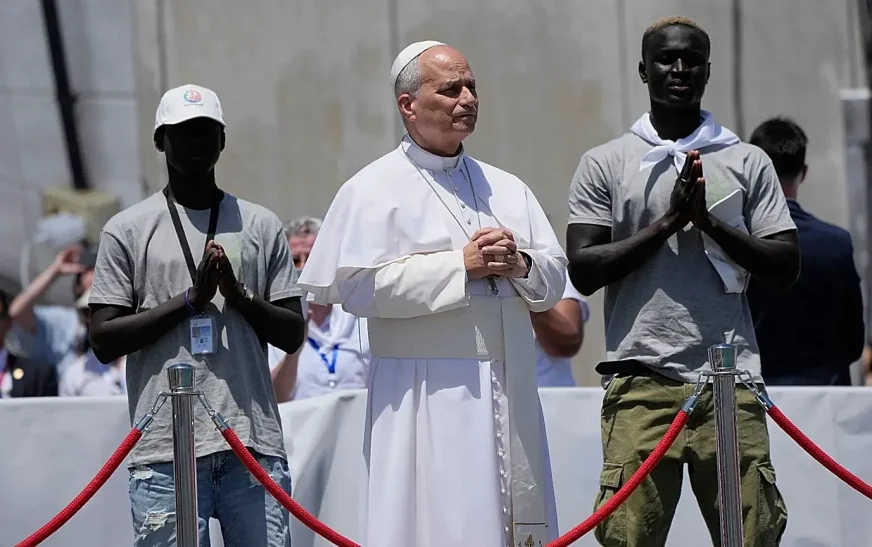
Pope Leo XIV has begun a two-day visit to Spain’s Canary Islands with a message focused on compassion, human dignity, and the challenges faced by migrants seeking a better life in Europe. During his visit, the Pope met with migrants, community leaders, and aid workers while drawing international attention to one of the world’s most dangerous migration routes.
The Canary Islands have become a major arrival point for people attempting to reach Europe from West Africa. Many migrants undertake long and risky journeys across the Atlantic Ocean in overcrowded boats, hoping to escape poverty, conflict, or limited economic opportunities in their home countries. While some successfully reach shore, many others lose their lives at sea.
In a symbolic gesture, Pope Leo threw a wreath of flowers into the ocean to honor those who died during these dangerous crossings. He lowered his head in prayer and called on European leaders and citizens not to become indifferent to the suffering of migrants. According to the Pope, every person risking such a journey has a story, a family, and hopes for a better future.
Addressing a gathering on Gran Canaria, the Pope emphasized that migrants should be viewed as human beings rather than statistics. He praised their courage and resilience while urging societies to respond with understanding rather than fear. His remarks highlighted the importance of recognizing the dignity of people who often face hardship, uncertainty, and discrimination.
Although the number of migrant arrivals in Spain has declined compared with previous years, many people continue attempting the crossing. International organizations report that dangerous sea routes remain active despite increased patrols and border controls. Humanitarian groups continue to express concern about the number of lives lost during these journeys.
Among those sharing their experiences was a young man from The Gambia who described leaving his family behind in search of opportunities abroad. Like many others, he boarded a crowded wooden boat and spent days at sea with limited food and water. The journey was filled with uncertainty, but he believed it offered the best chance of supporting his loved ones.
After reaching the Canary Islands, many migrants face additional challenges. Learning a new language, finding employment, securing legal residency, and adapting to a different culture can be difficult. For young adults, these obstacles are often even greater once they leave government support programs.
Several local organizations have stepped in to provide assistance. Community groups, charities, and religious organizations offer housing, education, language training, and employment support. Their goal is to help migrants build stable lives and become active members of society.
One local priest who works closely with migrants said many young people simply need guidance and opportunities. He argued that successful integration benefits both migrants and local communities. According to supporters of these programs, many industries in the Canary Islands are facing labor shortages and can benefit from new workers willing to contribute.
Spain’s government has also introduced measures that allow some undocumented migrants to regularize their status under specific conditions. Supporters view the policy as a practical response to labor shortages and humanitarian concerns. Critics, however, argue that such measures could encourage additional migration and place pressure on public services.
The debate over migration remains one of the most important political issues across Europe. Governments continue to discuss how to balance border security with humanitarian responsibilities. Some countries favor stricter controls, while others emphasize legal pathways for migration and stronger integration programs.
The European Union is also implementing new migration policies designed to strengthen border management and improve procedures for handling asylum applications. Supporters believe these measures will create a more organized system, while critics worry they could make it harder for vulnerable people to seek protection.
During his visit, Pope Leo repeatedly called for safe and legal migration options. He argued that creating lawful pathways would reduce the need for dangerous sea crossings and help prevent further loss of life. He stressed that people should not have to risk death in order to pursue safety, opportunity, or a better future for their families.
For many residents of the Canary Islands, migration is not just a political topic but a daily reality. Local communities, businesses, and aid organizations regularly interact with newcomers arriving from across Africa. Their experiences have shaped a broader conversation about solidarity, economic needs, and shared humanity.
As his visit continues, Pope Leo’s message remains clear: migration should be approached with compassion and practical solutions rather than fear. While political debates are likely to continue, he hopes that greater understanding and cooperation can help save lives and create more opportunities for those seeking a safer future.